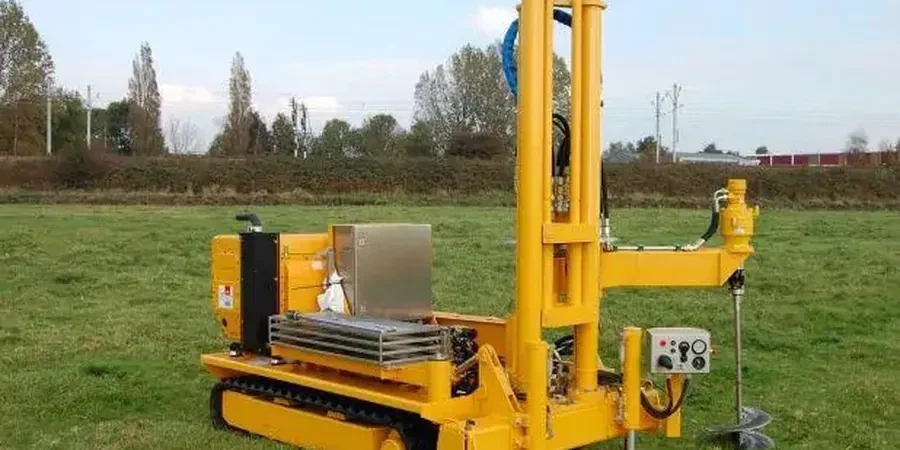
Plenty of builders along the Central Coast assume a few boreholes will tell them everything they need to know. Then they hit a lens of soft estuarine clay near Tuggerah that the rig missed entirely, and the piling budget blows out before the slab is even poured. That gap in the data is exactly what a CPT (Cone Penetration Test) closes. We run a 20-tonne penetrometer truck across the Central Coast NSW, pushing a cone through sands, clays, and mixed alluvium to give you a continuous, high-resolution profile of tip resistance, sleeve friction, and pore pressure. For sites where the Hawkesbury sandstone is deep and the overburden is variable, the CPT picks up thin compressible layers that a standard test pit simply cannot resolve, and it feeds directly into pile capacity models when you are planning a deep excavation near the Gosford waterfront.
A CPT profile reveals what a standard borehole misses: the thin, compressible seams that drive differential settlement on the Central Coast.
Technical details of the service in Central Coast NSW
- Continuous cone resistance, friction ratio, and pore pressure at 10 mm intervals
- Direct correlation to pile unit skin friction and end bearing
- Pore pressure dissipation tests to estimate consolidation characteristics
- Soil behaviour type classification using normalized SBT charts
- Equipment calibrated to ASTM D5778 and logged to AS 1726 field standards
- Seismic CPT module available for shear wave velocity profiling
Working video
Risks and considerations in Central Coast NSW
The Central Coast weather swings from drought-hardened clay in summer to saturated profiles after a week of east-coast lows. That seasonal contrast changes everything for a CPT. In the dry months, stiff near-surface clays around Lisarow can push back hard and demand anchor augering to get the truck stable. After heavy rain, the same site turns boggy and the rig needs timber mats just to reach the test location without leaving ruts. More importantly, the groundwater table migrates significantly between seasons, and that directly shifts the effective stress profile you are using for liquefaction screening. A CPT run in September when the water table is near the surface gives very different excess pore pressure readings compared to a February test after six weeks of dry heat. We schedule dissipation tests at the depth where you expect the highest stress change so the liquefaction assessment stays conservative regardless of the season.
Our services
Our Central Coast CPT service covers the full workflow from site access assessment through final parameter reporting. We operate across the entire region, from the Bouddi Peninsula up to Lake Macquarie, and we know which local councils want a traffic management plan before we even park the truck.
Standard Piezocone Testing
Continuous CPTu profiling with real-time pore pressure measurement. Ideal for stratigraphic logging, preliminary pile design, and detecting soft clay layers in mixed alluvial profiles.
Pore Pressure Dissipation Tests
Stopped-cone dissipation tests to estimate horizontal coefficient of consolidation and in-situ equilibrium pore pressure. Critical for settlement rate analysis on compressible estuarine soils.
Seismic CPT Add-on
Shear wave velocity measurement at selected depths using a downhole seismic module. Provides Vs profiles for site classification under AS 1170.4 without a separate borehole campaign.
Top questions
How much does a CPT on the Central Coast cost?
Most single-day CPT mobilisations around the Central Coast fall between AU$240 and AU$410 per metre tested, depending on depth, access conditions, and whether you need dissipation or seismic add-ons. A shallow investigation to 10 metres at a straightforward site near Erina might sit at the lower end, while a deep push past 20 metres in tight access near Woy Woy will trend higher. We always provide a fixed-price quote after reviewing the site location and access constraints.
How deep can a CPT push on the Central Coast?
It depends entirely on the soil. In the loose to medium-dense sands common around Bateau Bay and The Entrance, we routinely reach 25 to 30 metres before refusal. In the stiff residual clays and weathered sandstone near Kariong, refusal often occurs between 8 and 15 metres. Our 20-tonne truck gives us more push capacity than a standard crawler rig, but we cannot penetrate rock or dense gravel layers.
What is the difference between CPT and SPT?
An SPT drives a split spoon sampler at discrete intervals, typically every 1.5 metres, and gives you a disturbed sample and a blow count. A CPT pushes an instrumented cone continuously through the soil, recording tip resistance, sleeve friction, and pore pressure every 10 millimetres. The CPT gives you a near-continuous profile, detects thin layers that an SPT would miss, and provides direct engineering parameters without the need for empirical blow-count corrections.
Do I need a borehole if I already have CPT data?
A CPT gives you continuous geotechnical parameters but does not recover a physical soil sample. For projects where you need to run lab tests like Atterberg limits, particle size distribution, or triaxial strength, you will still want at least one borehole or test pit to provide material for the laboratory. On many Central Coast jobs, we combine one or two boreholes with a grid of CPT soundings to get both the lab data and the high-resolution stratigraphy.
How fast can I get results after the CPT is done?
We typically deliver a draft CPT log and interpreted soil behaviour type profile within two business days of completing the fieldwork. If dissipation tests are included, the full report with consolidation parameters may take an extra day. For urgent jobs where the piling contractor is waiting on data, we can provide raw plots and a verbal summary on the same day.