The Central Coast's expansion from quiet holiday towns into a commuter belt between Sydney and Newcastle placed heavy demands on road infrastructure that the original timber-getter tracks never anticipated. The M1 Pacific Motorway carries over 80,000 vehicles daily through terrain where Hawkesbury sandstone ridges alternate with deep Quaternary alluvium, creating dramatically different support conditions for concrete pavements within a single project alignment. When a rigid pavement is designed without understanding these transitions, the result is stepped faulting at the joints and premature slab cracking that no amount of dowel bar retrofit can truly fix. Our geotechnical team approaches rigid pavement design by first characterising the subgrade variability that defines the Central Coast, combining laboratory testing of reactive clay potential with field modulus measurement to produce a foundation layer that keeps concrete slabs performing for decades under the region's heavy traffic loading.
A concrete pavement slab is only as strong as the subgrade it rests on, and on the Central Coast that subgrade can change character within 50 metres.
Technical details of the service in Central Coast NSW
- Subgrade CBR and resilient modulus testing per Austroads AGPT-T053
- Reactive clay shrink-swell assessment using AS 1289.7.1.1
- Concrete flexural strength verification at 7 and 28 days
- Joint load transfer efficiency modelling for dowelled and undowelled configurations
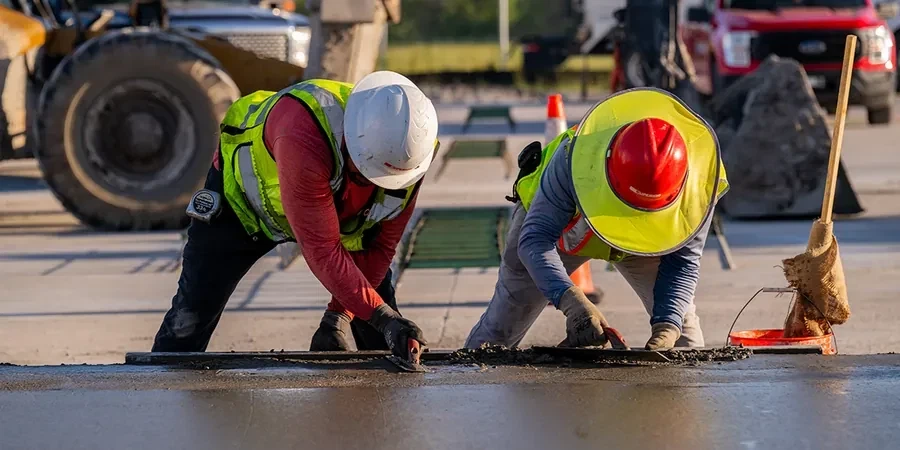
Risks and considerations in Central Coast NSW
The Central Coast's subtropical climate delivers over 1,200 millimetres of annual rainfall concentrated in summer and autumn, creating prolonged subgrade saturation that softens the pavement foundation at exactly the time when high temperatures induce upward slab curling. This combination produces voiding beneath slab corners under traffic, a progressive erosion mechanism that the pavement design must counter through adequate base stiffness and joint load transfer. Coastal sites near The Entrance and Wamberal face additional risk from saline groundwater attack on concrete matrix integrity, requiring consideration of sulfate-resistant cement blends and increased cover to reinforcement. Perhaps the most underestimated risk lies in differential movement where a pavement alignment cuts across a sandstone residual soil boundary: one slab end sits on essentially incompressible rock while the other bears on compressible clay, generating bending stresses that the structural design never accounted for. Our rigid pavement design process systematically identifies these transition zones and prescribes geotechnical treatments ranging from select fill undercut to cement-stabilised bridging layers.
Our services
Rigid pavement design on the Central Coast spans motorway widening projects, council road upgrades, and large-footprint industrial facilities. Each requires a tailored geotechnical investigation program to capture the site-specific subgrade conditions that feed directly into thickness design and joint detailing.
Subgrade Investigation and Treatment Design
Field plate load tests and dynamic cone penetrometer transects to establish the modulus of subgrade reaction across the pavement footprint, followed by lime stabilisation or select fill specifications where reactive clay or soft alluvium is encountered.
Concrete Pavement Thickness Design
Fatigue-based thickness calculations using cumulative axle load spectra and Westergaard edge-loading analysis, producing dowelled joint layouts and tie-bar schedules that manage the specific curling and shrinkage behaviour of Central Coast concrete mixes.
Industrial Hardstand and Container Pavement Design
Rigid pavement solutions for warehouse floors, container terminals, and loading docks where point loads from laden forklifts and reach stackers exceed typical highway loading, including joint armouring and steel-fibre reinforcement options.
Top questions
What is the typical design life for a rigid pavement on the Central Coast?
Austroads guides target a structural design life of 40 years for concrete pavements on major roads, and 20 to 30 years for residential and light-industrial pavements under AS 3727. Achieving these lifespans on Central Coast reactive clay sites depends heavily on the quality of subgrade preparation and joint sealing maintenance.
How does reactive clay affect rigid pavement performance?
Seasonal moisture changes cause reactive clay soils to shrink and swell, lifting slab edges in wet periods and leaving voids beneath them in dry spells. Without a stabilised subbase layer and appropriate joint spacing, this differential movement induces cracking and loss of load transfer at joints, accelerating pavement deterioration.
What is the difference between dowelled and undowelled joints for local conditions?
Dowelled joints use steel bars across the joint to transfer load between adjacent slabs, which is essential for heavy traffic on the M1 and arterial roads. Undowelled joints rely on aggregate interlock and are suitable for low-speed residential streets and footpaths, provided the slab length is kept within limits to control joint opening.
Do you test the concrete flexural strength before opening to traffic?
Yes, beam specimens are cast during pours and tested at 7 and 28 days per AS 1012.11 to confirm the characteristic flexural strength specified in the design. For fast-track projects, maturity testing can provide earlier strength confirmation to reduce construction programme delays.
What does rigid pavement design cost for a typical Central Coast project?
For a comprehensive design package covering subgrade investigation, thickness design, and joint detailing, fees typically range from AU$2,780 for a small residential driveway to AU$10,240 for a larger industrial hardstand or access road, depending on the investigation scope and traffic loading complexity. More info.