Setting up a hydraulic anchor drilling rig on a Central Coast site usually means preparing for two completely different ground profiles within the same borehole. The colluvium and residual soils across Gosford and Wyong are rarely more than three to five metres thick before the augers hit the Hawkesbury Sandstone or the Narrabeen Group siltstones. We run a Klemm 806 or similar compact crawler rig that can handle the tight access on steep bush blocks around Terrigal and Killcare, where the weathered rock can absorb grout unpredictably. Before any strand is fed into the hole, the in-situ permeability of the fractured bedrock dictates the grout mix design and injection pressure. Our team has seen too many anchors underperform simply because the bond length ended up in a zone of highly fractured, low-modulus material that was not identified during the initial site walk. In the Central Coast, anchor design is never a copy-paste exercise from a Sydney specification; the Triassic age geology here demands its own set of assumptions.
An active anchor in the Central Coast's weathered shales will lose 8-12% of its lock-off load in the first six months due to rock relaxation; this needs to be factored into the initial stressing procedure.
Technical details of the service in Central Coast NSW
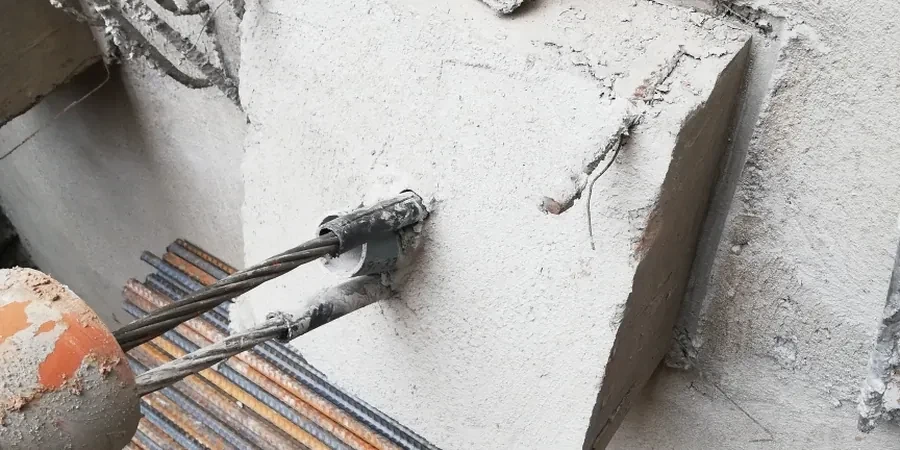
Risks and considerations in Central Coast NSW
The Central Coast's urban expansion from the 1960s onward pushed residential development onto steep terrain that was previously considered too difficult to build on. Suburbs like Green Point, Saratoga, and parts of Woy Woy sit directly on weathered shale slopes that creep imperceptibly during prolonged wet periods. Anchors installed in these formations without adequate free length can be subjected to bending stresses well beyond the assumptions in a standard axial design. The biggest risk we have observed over two decades of project work in the Central Coast is not anchor steel failure but a progressive bond zone deterioration caused by groundwater seepage through open joints in the sandstone. A bond length that provided 400 kN of capacity in October can degrade to 250 kN by March if the water chemistry is aggressive and the grout was not formulated for sulfate resistance. For this reason, we specify sulfate-resistant cement in all permanent anchor grouts across the Gosford LGA, and we recommend creep testing on the bond zone for any anchor with a design life exceeding 50 years.
Our services
Our anchor design and testing services for the Central Coast cover the full lifecycle from geotechnical investigation through to long-term monitoring. We work directly with structural engineers, shoring contractors, and council development assessors to produce documentation that satisfies the DA conditions for sites with slopes steeper than 18 degrees.
Permanent and Temporary Anchor Design
Complete design package including bond length calculations, free length verification, corrosion protection specification, and construction sequencing for both active prestressed and passive anchors. All designs are stamped by a CPEng geotechnical engineer registered in NSW.
Anchor Proof Testing and Lift-Off Monitoring
On-site supervision of anchor installation, sacrificial anchor testing to validate bond strength assumptions, proof loading of production anchors to 125-150% of design load, and long-term lift-off testing to measure load retention over the service life.
Top questions
What is the difference between an active and a passive anchor in practice?
An active anchor is tensioned against the structure at installation, applying a compressive force to the ground. We use these where movement must be minimised from day one—think of a deep excavation next to an existing house in Terrigal. A passive anchor is not stressed; it only engages when the ground starts to move. These are common in rock slope stabilisation where some relaxation is acceptable before the anchor picks up load. The choice depends on the allowable deflection for the structure you are retaining.
What is the typical cost range for anchor design and testing in the Central Coast?
For a complete design package including geotechnical investigation, design calculations, construction documentation, and on-site proof testing supervision, project costs in the Central Coast typically fall between AU$1,710 and AU$5,520. The final figure depends on the number of anchors, the complexity of the ground conditions, and the testing regime required by the certifying authority.
How deep do anchors need to be in Hawkesbury Sandstone?
In the medium to high strength Hawkesbury Sandstone common across the Central Coast, we typically design bond lengths between 3 and 6 metres. The exact length depends on the rock mass rating, fracture frequency, and the design load per anchor. We always verify the design with at least one sacrificial anchor test to failure before installing the production anchors, because the difference between a moderately weathered and a fresh sandstone unit can change the bond capacity by a factor of two.
Do I need council approval for anchor installation on a Central Coast property?
In most cases, yes. Central Coast Council will require a development application or a complying development certificate for retaining structures over one metre in height, and for any work within the geotechnical setback zone of a slope. Our design package includes the slope stability assessment and anchor design certification that the council's geotechnical reviewer will expect. We have worked with council on projects across the LGA and understand the specific information they require for a smooth approval process.