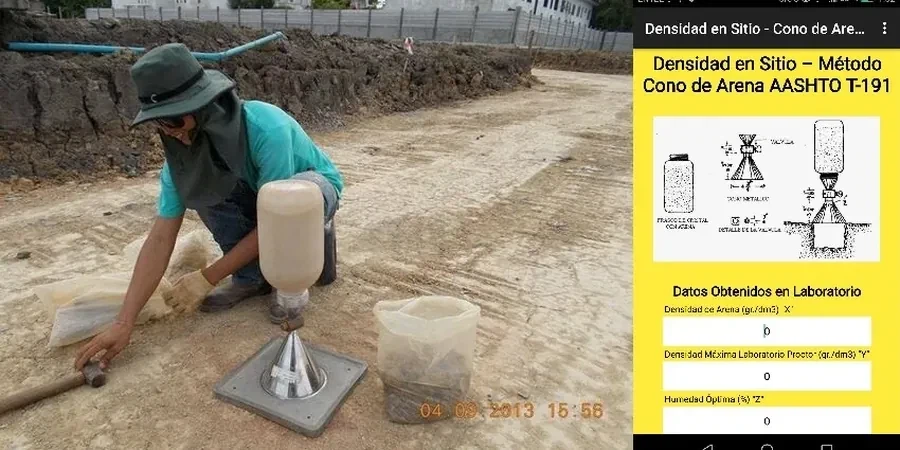
Coastal moisture and variable sandstone-derived fills make compaction verification on the Central Coast a different beast to inland Sydney work. We see it regularly when testing behind retaining walls in Terrigal or under slab preparations in Tuggerah: the sand cone method, run strictly to AS 1289.5.3.1, gives us a density reading that reflects real site conditions, not an assumption. The region’s high humidity and occasional salt spray don’t affect the Ottawa sand calibration, but they do demand that the technician checks moisture content onsite with a speedy or microwave before comparing against the laboratory Proctor tests reference curve. When the fill contains weathered sandstone fragments from cuttings around Kariong, we often pair the field density test with a grain size analysis to confirm that oversized particles aren’t skewing the maximum dry density value used for acceptance.
A single lift failing relative compaction by 4% can produce settlement that costs ten times the testing budget to rectify—sand cone results close that gap before the concrete pour.
Technical details of the service in Central Coast NSW
Risks and considerations in Central Coast NSW
With over 340,000 people living across the Central Coast LGA and development pushing into hillside subdivisions around Lisarow and Holgate, the risk of under-compaction on cut-and-fill sites has never been more relevant. The region’s average annual rainfall of 1,200 mm saturates poorly compacted fill, triggering differential settlement that shows up as cracked slabs and leaning retaining walls within the first two wet seasons. On a recent job in Green Point, a single lift tested at 92% relative compaction—just four points below the 96% minimum—was enough to cause 15 mm of slab edge settlement after heavy rain. Sand cone testing catches that before the concrete goes down. For deeper fills exceeding 600 mm, we recommend supplementing density tests with slope stability analysis where the fill batters approach the boundary, because a surface compaction pass doesn’t guarantee internal shear strength.
Our services
Ofrecemos un portafolio completo de servicios técnicos de densidad de campo (cono de arena) diseñados para proyectos de construcción, minería e infraestructura en Central Coast NSW.
Compaction Verification for Structural Fill
Sand cone density testing per AS 1289.5.3.1 on engineered fill beneath footings, slabs, and retaining walls. We test each lift before the next is placed, referencing the laboratory Proctor curve to confirm 98% or 100% relative compaction as specified. This is the standard acceptance method for residential and commercial earthworks from Woy Woy to Wyong.
Roadway and Pavement Subgrade Testing
Density control on subgrade and base course layers for driveways, car parks, and local road projects. We work to the compaction requirements in AS 3798 and council specifications—Central Coast Council often requires sand cone results on the subgrade before allowing the pavement crew to proceed. Testing frequency follows the lot size and material variability.
Trench and Pipe Zone Backfill Testing
Density checks on backfill in utility trenches, stormwater lines, and sewer alignments. The narrow excavation width in suburban Central Coast jobs means single-point testing per lift is usually sufficient, though we recommend two points where the trench crosses property boundaries or material changes. We test the pipe zone and the overlying fill separately to satisfy both the hydraulic and structural compaction criteria.
Top questions
What does a field density test with the sand cone method cost on the Central Coast?
For standard compaction verification on the Central Coast, a single sand cone test typically runs between AU$170 and AU$250 per point, depending on access and number of points on the day. That includes the field density determination, moisture content measurement, and a report comparing results to the laboratory reference curve. Sites requiring additional travel beyond the Gosford-Wyong corridor or weekend work may carry a surcharge; we quote the exact amount after confirming the location and approximate fill depth.
How many sand cone tests do I need for my driveway or slab preparation?
For a residential slab or driveway pad up to 150 m², AS 3798 typically calls for a minimum of three density tests per lift, with one test per 50 m² of compacted area. We increase the frequency when the fill material varies across the site—common on Central Coast blocks where cut-to-fill transitions expose both sandy soils and stiff clays within the same pad. Multi-lift fills require testing after each compacted layer, so a 300 mm fill placed in two 150 mm lifts would need at least six test locations.
Can the sand cone method be used on coarse gravel or crushed sandstone fill?
The sand cone method is reliable for soils with a maximum particle size up to about 37.5 mm. When the fill contains a significant proportion of oversize material—such as crushed Hawkesbury sandstone with cobbles larger than that—the test cavity walls become irregular and the Ottawa sand cannot fully replicate the void. In those cases we recommend running a CPT test alongside a few sand cone points to correlate density, or switching to a nuclear gauge where permitted. Our team assesses particle size on the first visit and adjusts the method if the fill is too coarse for the cone.
How long does it take to get results from a field density test?
Field density values are calculated on site within about 20 minutes per point, so the technician can tell you immediately whether the lift passes or fails the specified relative compaction—typically 98% or 100% of standard Proctor for structural fill on the Central Coast. The formal report with GPS coordinates, layer identification, and comparison to the laboratory compaction curve is emailed the same afternoon or by 10:00 AM the following business day. Where results affect the pour schedule, we provide a verbal pass/fail straight away.