A recent warehouse extension off the M1 at Somersby caught everyone off guard. The site investigation logs showed decent sandy clays, but the subgrade soaked up moisture fast during the earthworks cut. The contractor needed a soaked laboratory CBR test value on the double to confirm the pavement design assumptions before laying the first layer of select fill. We see this pattern all the time across the Central Coast NSW corridor. The geology here shifts rapidly between Hawkesbury sandstone residuals and low-lying alluvial pockets, and the laboratory CBR test becomes the decision-maker between a standard pavement section and a costly lime-stabilised subgrade. In our experience, running the CBR early, on samples compacted at the target density and moisture from the site's own Proctor tests, saves weeks of rework once the grader is on the pad. For sites with variable fill, we cross-check the lab CBR against in-situ permeability data to understand how water will move through the formation over a wet La Niña cycle.
Soaked CBR at field density tells you more about long-term pavement performance than any unsoaked value ever will.
Technical details of the service in Central Coast NSW
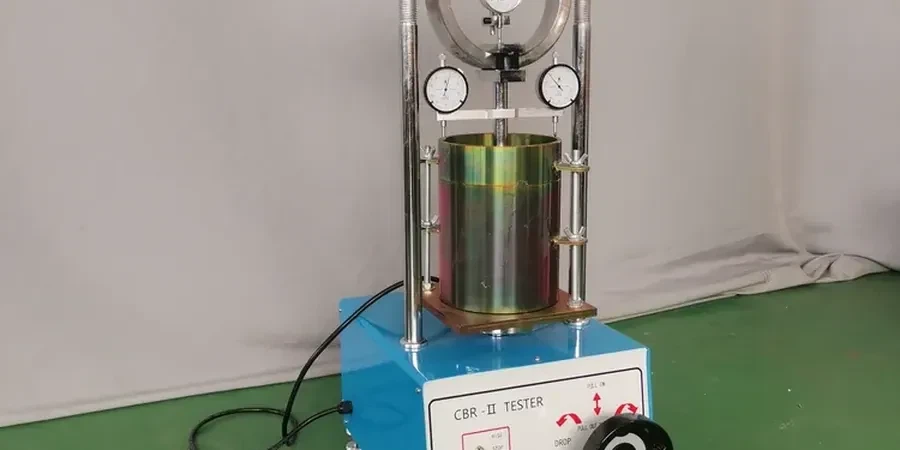
We compact the material in a standard CBR mould at modified or standard Proctor effort, depending on the project spec. After soaking, we measure swell and then take the plunger penetration readings at 0.025-inch increments. The result is expressed as a percentage of the standard crushed rock reference, and we report both the CBR value and the swell percentage. For road authority projects, the laboratory CBR test often needs to be paired with a grain-size analysis to confirm the fines content meets the authority's threshold for a selected material zone.
Risks and considerations in Central Coast NSW
The Central Coast NSW has grown fast, and not all land was developed with pavement performance in mind. Older industrial subdivisions around Gosford and Wyong were built on compacted fill of unknown origin. When a pavement fails prematurely, the root cause often traces back to an overestimated CBR value from an unsoaked test on a sample dried back in the sun. The real risk is designing a pavement for a CBR of 12% when the soaked value sits closer to 4%. That gap equals rutting, crocodile cracking, and basecourse pumping after the first wet season. A single laboratory CBR test result, taken out of the moisture-suction context of the site, can mislead an entire pavement design. The cost of a properly conditioned laboratory CBR test is negligible compared to a pavement rehabilitation contract. Our technical team always recommends running the soaked CBR on specimens compacted at the target field density and moisture content range identified from the Proctor curve, not just at optimum.
Our services
The laboratory CBR test sits inside a broader pavement investigation workflow. Here is what we typically combine it with for Central Coast NSW projects:
Modified Proctor compaction
Determines the maximum dry density and optimum moisture content for the material before CBR specimen preparation.
Swell measurement
We record the swell of the specimen during the 4-day soak, a key input for expansive subgrade assessment.
Grain-size distribution
Sieve and hydrometer analysis to classify the material and check compliance with road authority selected fill specs.
In-situ density correlation
We compare lab CBR with field density and moisture from sand cone tests to validate the design CBR assumption.
Top questions
How much does a laboratory CBR test cost in Central Coast NSW?
For a single-point soaked CBR test per AS 1289.6.1.1, you can expect to pay between AU$200 and AU$340, depending on whether Proctor compaction is included and the number of points required. A full suite with Proctor plus 3-point CBR is at the higher end of that range.
How long does the lab CBR test take?
The soaked CBR requires a 4-day soaking period, so the full test takes about 5 working days from sample arrival to final report. Unsoaked CBR can be turned around in 2 days if the Proctor data is already available.
Can you test CBR on material with gravel larger than 19 mm?
The standard CBR mould is 152 mm diameter, and AS 1289 allows material up to 19 mm. For material with oversize particles, we scalp the sample on the 19 mm sieve and report the percentage removed, per the standard.
What moisture condition gives the most reliable CBR for pavement design?
The soaked CBR at a density representative of field compaction is the most reliable. We typically prepare specimens at the target field moisture content range, not just at optimum, and soak them for 4 days to simulate the worst-case saturated condition the subgrade will experience during its service life.
Do I need Proctor data before running the CBR test?
Yes, you need the maximum dry density and optimum moisture content from a Proctor test to compact the CBR specimens at the correct effort and moisture. We can run both tests on the same bulk sample, which is the most common workflow for Central Coast NSW pavement investigations.