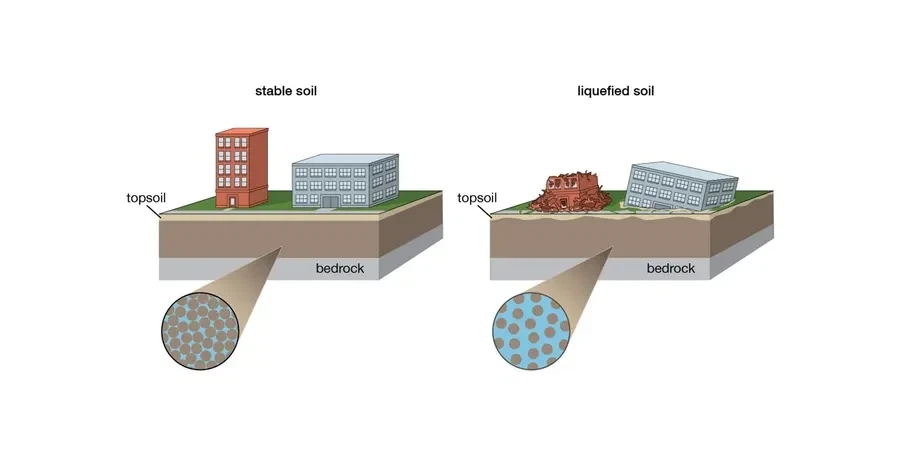
The most expensive mistake we see on the Central Coast is treating liquefaction as a ‘Newcastle problem’ and skipping it here. The deep sands in Tuggerah and the paleochannels under Wyong don't read textbooks — they fail on their own terms. A standard site classification won't flag it if you're not looking at depth, groundwater and fines content together. We've pulled silty sand cores from 6 metres down in areas that look fine on a 2-metre test pit log, but trigger strain softening under a 1-in-500-year event. When the water table is sitting at a metre below ground level — common across the coastal floodplain — the risk equation changes completely. Getting the analysis right means running site-specific CPT testing to capture thin sand layers that SPT blow counts miss, and pairing that with grain-size distribution curves to confirm whether the fines content actually suppresses or accelerates excess pore pressure. You don't want to find out the difference during a claim.
Liquefaction in the Central Coast isn't driven by plate boundary quakes — it's the shallow, moderate-magnitude Newcastle-style events that shake loose saturated sands the hardest.
Technical details of the service in Central Coast NSW
Risks and considerations in Central Coast NSW
The paleochannel sands under Tuggerah Lakes and the old floodplain deposits around Avoca Lagoon weren't deposited by high-energy rivers — they're low-density estuarine fills that densify poorly under natural consolidation. When the cyclic stress ratio from a Newcastle-style event hits a loose sand at 4 metres depth with the water table at 1.2 metres, the factor of safety drops below 0.8 in our models. That's not a marginal case; that's full liquefaction triggering with volumetric strain driving 50 to 80 millimetres of differential settlement across a building footprint. We've mapped this across multiple sites in the Wyong employment zone. The consequence isn't just a cracked slab — for structures on shallow footings without ground improvement, it's a total loss of bearing capacity for the duration of shaking. Lateral spreading toward open water or creek channels adds another failure mode that standard residential codes don't address explicitly, but AS 4678 and the local council's flood-prone land policies expect the geotechnical engineer to flag it.
Our services
Every liquefaction job we run on the Central Coast ends up needing a slightly different toolkit depending on access, depth and the consequence category of the structure. These are the two starting points we recommend most:
Site-specific liquefaction triggering assessment
Full CPTu or SPT-based analysis with depth-specific FSL calculation, post-liquefaction volumetric strain and settlement estimates, delivered with borehole logs, lab test certificates and a signed geotechnical report suitable for DA submission to Central Coast Council.
Ground improvement design for liquefaction mitigation
Design of stone columns, vibrocompaction or deep soil mixing arrays targeting the critical layer, with verification testing programme (post-treatment CPT) and construction QA documentation. We write the performance spec so contractors bid against a measurable target density.
Top questions
Do I need a liquefaction assessment for a single house on the Central Coast?
It depends on your site's soil class and the council's flood and coastal hazard mapping. If the borehole log shows loose, saturated sands (SP or SM) below the water table within the top 10 metres, AS 1726 and the NSW State Environmental Planning Policy expect you to address it. We can often clear a site with a targeted CPT and a lab grading curve rather than a full cyclic triaxial programme, keeping the cost down while meeting the DA conditions.
What does a liquefaction analysis cost for a typical commercial lot in Tuggerah?
For a standard commercial lot in the Tuggerah area, a complete liquefaction assessment — including drilling, CPTu, lab testing and the signed report — typically falls between AU$3,570 and AU$5,620 depending on depth to bedrock and the number of critical layers we need to sample for cyclic testing. We'll give you a fixed-price proposal once we've seen the survey plan and the existing site data.
How long does the field and lab work take before I get the report?
Fieldwork is usually one to two days with a CPT rig and a drilling crew working together. The lab cyclic triaxial tests need about three to four weeks for sample consolidation and staged loading. We issue a preliminary FSL summary within ten working days of the field work so your structural engineer can start the foundation design, with the full NATA-endorsed report following once all lab data is in.
Can you use existing borehole logs, or do you need new drilling?
We can work with existing logs if they have standard penetration test data with calibrated hammer energy and accurate groundwater readings at the time of drilling. The catch is that most generic site investigation logs on the Central Coast don't record the fines content or plasticity of the sandy layers, which are essential for the liquefaction resistance correction. We usually recommend at least one CPT sounding and a targeted mud rotary borehole to recover undisturbed samples — it's faster than arguing with an incomplete dataset.