Site investigation across the Central Coast NSW defines the critical first step in understanding the complex near-surface geology, from the deep residual soils of the Hawkesbury Sandstone ridgelines to the alluvial and estuarine clays of the Tuggerah Lakes catchment. Our approach aligns with AS 1726, systematically mapping stratigraphy and groundwater conditions to de-risk earthworks and foundation design. High-resolution CPT (Cone Penetration Test) profiling is deployed to continuously measure tip resistance and sleeve friction, enabling precise identification of soft clay lenses and dense sand layers that dominate the coastal plain.
This data underpins residential slabs on the expansive clays of Narara, commercial basements in Gosford’s CBD, and infrastructure corridors crossing reactive soil zones. Where soft alluvium demands rigorous bearing capacity assessment, we pair CPT with laboratory triaxial testing and geotechnical drilling to extract undisturbed samples. For road widening or bridge approaches on the M1, our dynamic cone penetrometer and geophysics services rapidly map bedrock depth and detect voids in the weathered sandstone profile, ensuring ground models are defensible and construction-ready.
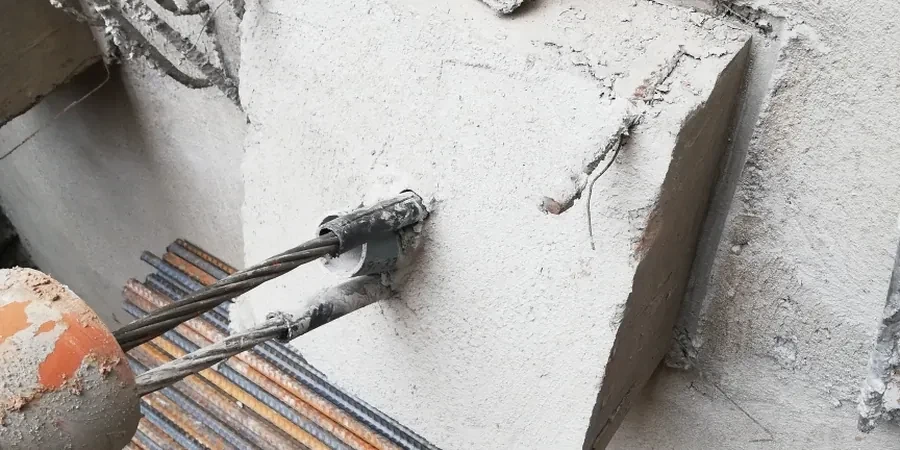
An active anchor in the Central Coast's weathered shales will lose 8-12% of its lock-off load in the first six months due to rock relaxation; this needs to be factored into the initial stressing procedure.
Technical details of the service in Central Coast NSW
Risks and considerations in Central Coast NSW
The Central Coast's urban expansion from the 1960s onward pushed residential development onto steep terrain that was previously considered too difficult to build on. Suburbs like Green Point, Saratoga, and parts of Woy Woy sit directly on weathered shale slopes that creep imperceptibly during prolonged wet periods. Anchors installed in these formations without adequate free length can be subjected to bending stresses well beyond the assumptions in a standard axial design. The biggest risk we have observed over two decades of project work in the Central Coast is not anchor steel failure but a progressive bond zone deterioration caused by groundwater seepage through open joints in the sandstone. A bond length that provided 400 kN of capacity in October can degrade to 250 kN by March if the water chemistry is aggressive and the grout was not formulated for sulfate resistance. For this reason, we specify sulfate-resistant cement in all permanent anchor grouts across the Gosford LGA, and we recommend creep testing on the bond zone for any anchor with a design life exceeding 50 years.
Our services
Our anchor design and testing services for the Central Coast cover the full lifecycle from geotechnical investigation through to long-term monitoring. We work directly with structural engineers, shoring contractors, and council development assessors to produce documentation that satisfies the DA conditions for sites with slopes steeper than 18 degrees.
Permanent and Temporary Anchor Design
Complete design package including bond length calculations, free length verification, corrosion protection specification, and construction sequencing for both active prestressed and passive anchors. All designs are stamped by a CPEng geotechnical engineer registered in NSW.
Anchor Proof Testing and Lift-Off Monitoring
On-site supervision of anchor installation, sacrificial anchor testing to validate bond strength assumptions, proof loading of production anchors to 125-150% of design load, and long-term lift-off testing to measure load retention over the service life.