The Central Coast region of New South Wales presents a unique challenge for tunnelling engineers: the transition zones between the rigid Hawkesbury Sandstone and the deep alluvial deposits of the coastal plain. In areas like Gosford and Wyong, soft soil tunnels often encounter compressible estuarine clays with undrained shear strengths below 25 kPa, demanding a geotechnical analysis that goes well beyond standard site classification. When groundwater levels sit just 1.5 to 3 metres below the surface—a common scenario in the Narara Creek floodplain—the risks of face instability and excessive settlement multiply. A rigorous investigation combining advanced laboratory testing with field-derived parameters is not optional; it is the foundation of any viable soft-soil tunnelling strategy in Central Coast NSW. We routinely integrate CPT testing data to map the continuous stratigraphy, which is essential for refining the tunnel boring machine (TBM) parameters before a single metre is excavated.
Predicting face stability in Central Coast soft soils requires triaxial testing that replicates the exact stress path of the advancing tunnel, not just index properties.
Technical details of the service in Central Coast NSW
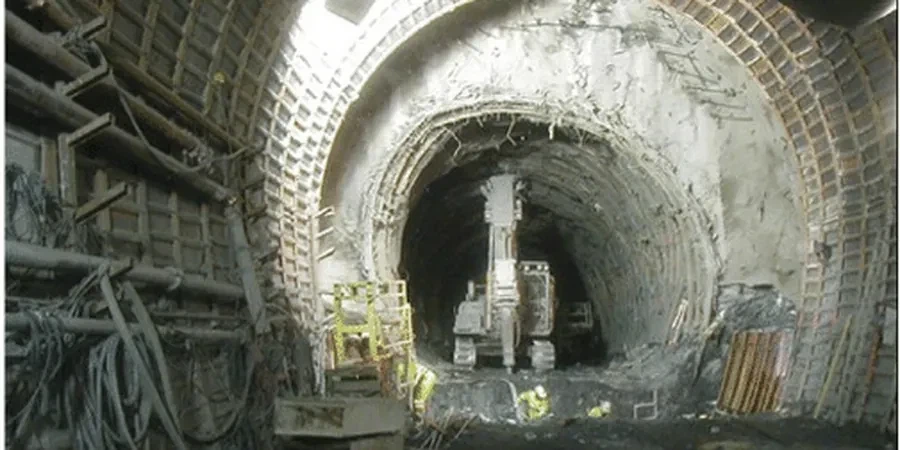
Risks and considerations in Central Coast NSW
Residential and commercial development in Central Coast NSW has pushed infrastructure into areas once considered unsuitable for tunnelling. The region, which houses over 340,000 residents, relies on critical links like the M1 Pacific Motorway where underground service tunnels must pass beneath without disrupting traffic. A geotechnical analysis for soft soil tunnels that overlooks the sensitivity of the local estuarine clays risks triggering a catastrophic chimney collapse, especially where the cover-to-diameter ratio is less than 2.0. The high plasticity of the Wyong formation means volume loss at the face can translate directly into settlement troughs at the surface, threatening existing structures. Mitigating this requires a detailed geotechnical model that accurately captures the non-linear stiffness degradation of the soil, enabling the design of a TBM that maintains face pressure within a very narrow operational window.
Our services
Our geotechnical analysis for soft soil tunnels in Central Coast NSW is built around a phased investigation that moves from regional geological models to site-specific parameter selection. Every programme is calibrated to the specific groundwater regime of the project site.
Advanced Laboratory Testing for Soft Soil Parameters
We perform CU triaxial tests with pore pressure measurement on undisturbed tube samples to define the undrained strength profile and deformation modulus for your Central Coast tunnel alignment. This includes one-dimensional consolidation testing to assess the settlement potential of the compressible estuarine clays found across the region.
Face Stability and Settlement Risk Assessment
Using the derived soil parameters, our engineers model the expected volume loss and surface settlement trough width. This analysis directly informs the required face support pressure for EPB machines operating in the soft alluvial soils and saprolitic transition zones common in the Gosford area.
Top questions
What is the typical cost range for a geotechnical investigation for a soft soil tunnel in Central Coast NSW?
The investigation cost typically ranges from AU$5.810 to AU$24.280, depending on the length of the alignment, the number of boreholes required to capture the variability of the alluvial deposits, and the complexity of the laboratory testing programme specified.
How do you define the soil parameters for a TBM in the Wyong formation?
We define TBM parameters by conducting a series of consolidated-undrained triaxial tests on high-quality thin-wall tube samples. This allows us to determine the undrained shear strength, stiffness, and pore pressure response of the Wyong clays under the confining stresses relevant to your tunnel depth.
Which Australian standards govern the geotechnical analysis for these tunnels?
The primary standards are AS 1726:2017 for site investigations and AS 4678:2002 for earth retaining structures. We also apply the Austroads Guide to Road Tunnels and relevant ASTM standards for advanced laboratory testing to ensure a comprehensive design basis.
How do you address the risk of groundwater inflow in Central Coast alluvial soils?
We map the permeability profile through in-situ falling head tests and laboratory permeability assessments. This data is used to model steady-state seepage into the excavation, which then informs the dewatering strategy and the required TBM sealing system to maintain face stability.