Across the Central Coast, from the weathered Hawkesbury Sandstone ridges around Gosford to the alluvial flats near Tuggerah Lakes, groundwater behaviour often dictates the success of a project. We have seen too many cut-and-cover excavations stall because the contractor assumed a soil was impermeable based on a desktop study alone. The Central Coast’s residual clayey sands and fractured rock masses don’t always behave as the borelogs suggest, which is why we run field permeability tests directly on the material in situ. Whether you are designing a retention basin in Narara or planning dewatering for a deep sewer shaft in Woy Woy, the Lefranc and Lugeon methods give you the mass hydraulic conductivity, not a remoulded lab value. Combining this data with a CPT profile often reveals the true drainage boundary that controls pore pressure dissipation during construction.
A single in-situ permeability test on a structured soil or fractured rock can reveal flow regimes that remoulded lab samples will never capture.
Technical details of the service in Central Coast NSW
Risks and considerations in Central Coast NSW
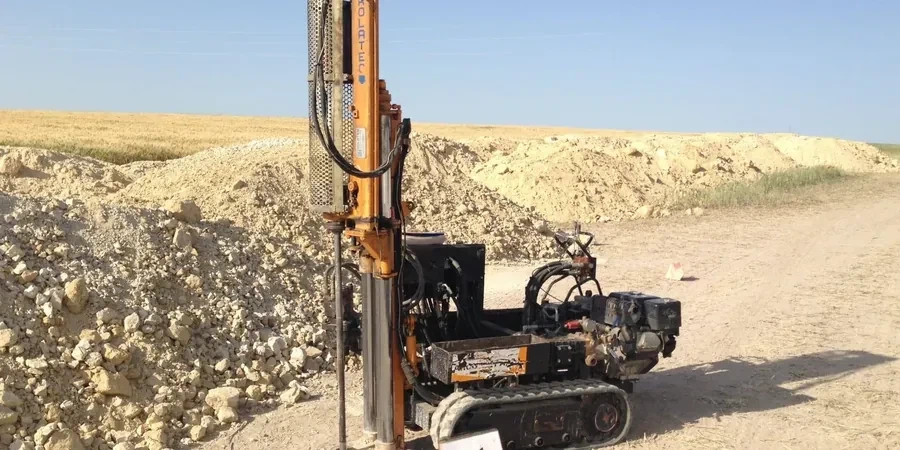
We run these tests with a pneumatic packer assembly lowered on AW or NW drill rods, sealing off a discrete interval below the casing. On the Central Coast’s steeper blocks, where access tracks snake up to ridgeline homesites, we often mobilise a compact rubber-tracked rig that can sit on a 20-degree slope without benching. The biggest risk is bypass: if the packer doesn’t seat properly in a fractured, vuggy zone of the Terrigal Formation, injection water short-circuits up the annulus and your Lugeon value is meaningless. We counteract this by running a pre-test with a downhole camera or caliper log on deeper holes, and by using double packers when the rock is too broken to trust a single seal. For Lefranc tests in silty sand, the cavity must be carefully developed without smearing the sidewalls; otherwise the test reads an artificially low permeability and the excavation dewatering system ends up undersized. We’ve corrected that exact problem on three sites in the Tuggerah business park area.
Our services
Our field permeability testing on the Central Coast NSW covers the full spectrum of in-situ hydraulic characterisation, from shallow soils to deep rock.
Lefranc testing in soils
Constant or falling head tests in cased boreholes for alluvial and residual soil profiles. We isolate the test zone with a slotted screen and gravel pack, then record flow rates to derive k-values for dewatering design, landfill liners, and stormwater infiltration basins.
Lugeon testing in rock
Pressurised packer testing in drillholes across fractured sandstone, shale, and coal measures. The five-stage pressure cycle identifies laminar, turbulent, dilation, and washout flow regimes, providing data for grout curtain design, dam abutment assessment, and deep excavation cutoff walls.
Combined permeability and CPT profiling
When the stratigraphy is variable—common in the estuarine margins of Brisbane Water—we pair field permeability tests with piezocone dissipation tests to map the drainage boundary across a site, reducing the number of boreholes needed for a representative hydrogeological model.
Top questions
What’s the difference between a Lefranc test and a lab permeability test?
A lab test measures the permeability of a small, remoulded or intact specimen, typically 75 mm in diameter. A Lefranc test measures the mass hydraulic conductivity of the soil in situ over a much larger volume, capturing the effect of fissures, root holes, sand lenses, and relic jointing that lab samples miss. On Central Coast residual soils, the in-situ value is often 10 to 100 times higher.
When do I need a Lugeon test instead of a Lefranc test?
Lugeon tests apply to rock. If your project involves a dam foundation, a grout curtain, a rock-socketed pile, or a deep shaft in sandstone or coal measures, you’ll need Lugeon values. The test uses a packer to isolate a section of drillhole and injects water under pressure. The resulting Lugeon unit (1 Lu ≈ 1.3 \u00d7 10⁻⁷ m/s) tells you how tight or fractured the rock mass is.
How much does field permeability testing cost on the Central Coast?
For a standard Lefranc or Lugeon test package on the Central Coast, budgets usually fall between AU$1,100 and AU$1,650 per test zone, depending on depth, access, and whether single or double packers are required. A full day of testing with mobilisation generally runs toward the upper end. We provide fixed-price proposals once we review the borehole logs and access conditions.
How long does it take to get results from a field permeability test?
The field test itself takes one to two hours per zone, including setup, saturation, and the staged pressure cycle for a Lugeon test. We provide preliminary k-values and flow-versus-pressure plots within 24 hours by email. The final report, signed by our geotechnical engineer and cross-referenced to the AS 1726 borelogs, is typically issued within three working days.