On the Central Coast, you learn quickly that the ground profile rarely matches the borehole log from three properties over. In suburbs like Tuggerah or Berkeley Vale, a dense sand layer can feather out into a pocket of organic silt within the same building footprint, which makes standard shallow footings a gamble. Stone column design addresses this by creating stiff, draining inclusions that transfer load past the soft layers and into the bearing strata below, while the CPT testing program provides the continuous stratigraphic detail needed to terminate the columns at a competent horizon. Our team works from the understanding that a stone column grid on the Central Coast has to handle settlement tolerance, lateral confinement, and the drainage demands of a site where the water table sits barely a metre below the grass.
A stone column transfers load through the weakest soil by replacing it with a stiff, draining column that engages the surrounding ground through lateral confinement.
Technical details of the service in Central Coast NSW
Risks and considerations in Central Coast NSW
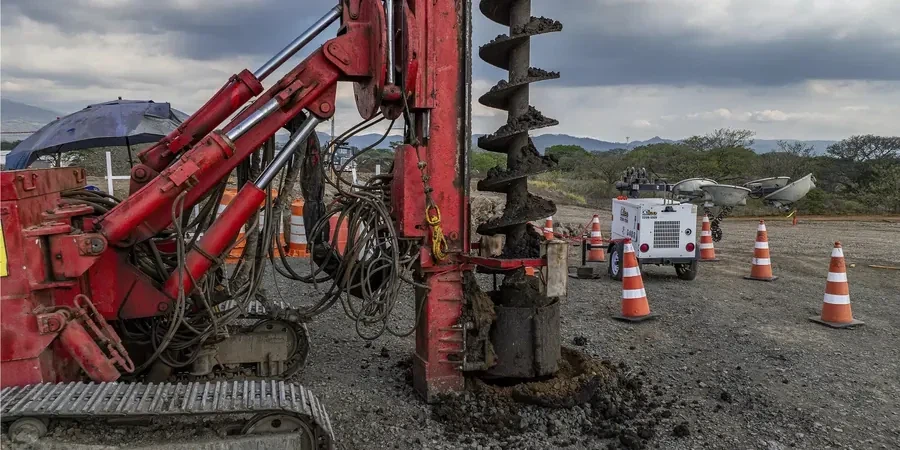
The vibro-flot arrives on a low-loader, the skip fills with graded basalt or crushed sandstone aggregate, and the probe begins penetrating at a steady rate while compressed air keeps the bore open. On a Central Coast site, skipping the column load test before full production puts the entire floor slab at risk because the gravel stiffness degrades quickly if the lateral confinement from the surrounding soil is lower than assumed. A single plate load test on an isolated column, or better yet a group test with settlement markers, costs a fraction of a production run but validates the design assumptions under real groundwater conditions. Without it, the contractor is effectively guessing whether the column will punch into a thin peat lens that the site investigation may have missed between borings.
Our services
The following packages cover the stages needed for a stone column ground improvement project on the Central Coast, from the initial feasibility assessment through to verification testing.
Design and specification package
Includes settlement analysis, column spacing and length determination, gravel gradation specification, and load test criteria. We prepare the full set of construction drawings and the technical specification for tender, referencing AS 4678 and the site-specific geotechnical model.
On-site verification and load testing
We supervise the trial column installation, conduct plate load tests and modulus tests on individual and grouped columns, and review the production records against the design assumptions to confirm that the target composite stiffness has been achieved across the grid.
Top questions
How much does a stone column design for a typical Central Coast residential block cost?
For a standard residential or light commercial site on the Central Coast, the design package generally falls between AU$2.460 and AU$7.570, depending on the number of columns, the complexity of the soil profile, and the amount of verification testing required. A site with multiple soft layers and variable rock-head depth will sit at the upper end of that range because the analysis needs more CPT data and a finer column grid.
How deep do stone columns typically need to go on the Central Coast?
Depth is dictated by the level of the competent bearing stratum, not by a fixed number. In areas like Tuggerah or Wyong, columns often run 6 to 12 metres to get through the estuarine clays and reach dense sands, but where a paleochannel cuts deeper or the Hawkesbury sandstone drops away, lengths can exceed 15 metres. The CPT log is the best tool to confirm the termination depth before the rig starts.
What information do you need to start the stone column design?
We need a geotechnical investigation with SPT or CPT data that extends at least 3 metres into competent ground, laboratory classification of the soft layers (Atterberg limits, organic content, undrained shear strength), and a site survey showing the building footprint and finished floor level. With that, we can run the settlement analysis and produce a column layout within about two weeks.