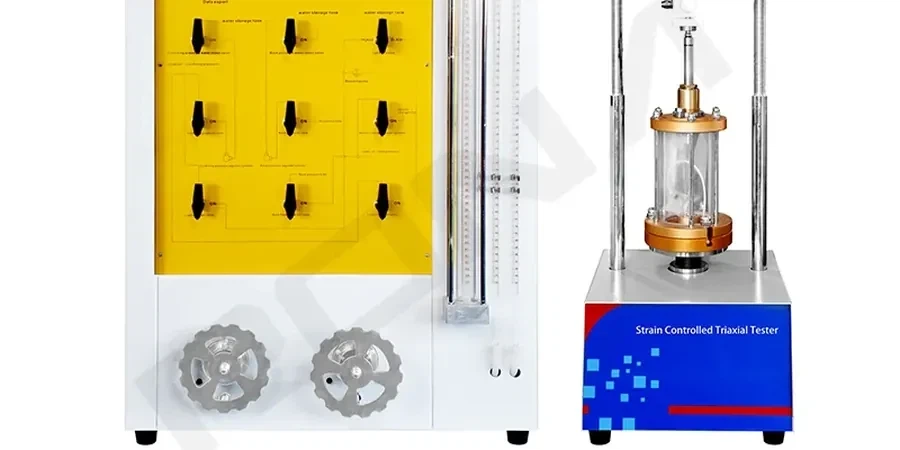
A Wykeham Farrance triaxial cell sits inside a temperature-controlled lab in Gosford, running a staged shearing sequence on a stiff silty clay core from Erina. The cell pressure holds at 200 kPa while the load frame drives the piston downward at 0.02 mm per minute. This is a consolidated-undrained test with pore pressure measurement—standard protocol when we need drained and undrained strength parameters for a cut slope off the Pacific Highway. Central Coast geology rarely fits textbook assumptions. Sandstone weathering grades shift from Class III to Class V across a single lot, and residual clay pockets left by the Narrabeen Group demand more than just index testing when the design calls for a shoring system or a cut deeper than three metres. Our triaxial testing program gives designers the cohesion intercept and friction angle they actually need, measured on specimens trimmed from thin-walled tubes taken right at the project site. We run effective stress paths for slope stability analysis and total-stress envelopes where short-term loading governs the excavation sequence.
Triaxial strength parameters from a single Central Coast sample often reveal more about the design risk than a full set of SPT N-values from the same borehole.
Technical details of the service in Central Coast NSW
Risks and considerations in Central Coast NSW
A residential subdivision at Terrigal was designed using generic friction angles from a desk study. Site investigation later confirmed the cut would intersect a gently dipping claystone band within the Terrigal Formation, and the assumed φ' was off by six degrees. The triaxial program we ran on oriented specimens from that band showed the true effective friction angle and the strain-softening behaviour that would kick in after peak strength. The design was reworked with a flatter batter and a drainage system that intercepted the seepage plane before it daylighted into the excavation. Without the triaxial data, the slope would have stood for a season and then failed after a heavy east-coast low. When a geotechnical model on the Central Coast relies on a single strength envelope for a weathered profile, the risk sits in the layer nobody tested. Triaxial tests let the designer check each material unit—residual clay, extremely weathered rock, moderately weathered sandstone—and assign parameters that actually reflect the geology, not a conservative guess that still might miss the controlling failure surface.
Our services
Our Central Coast triaxial testing program covers the full range of loading and drainage conditions required for local geotechnical design. We prepare specimens in-house from thin-walled tube samples or block samples, and we can run single-specimen multi-stage tests where core recovery is limited. Turnaround is typically seven to ten working days; urgent jobs can be prioritised if the rig is on standby.
Consolidated-Undrained (CU) with pore pressure
Effective stress parameters c' and φ' plus total stress envelope for short-term analysis of cuts and foundations in low-permeability Central Coast residual soils.
Consolidated-Drained (CD)
Drained friction angle for free-draining fills, sandstone-derived granular materials, and long-term stability of permanent retaining structures.
Unconsolidated-Undrained (UU)
Quick undrained shear strength for preliminary assessments in saturated clays and for checking vane shear correlations at soft-soil sites.
Multi-stage triaxial
Three shearing stages on a single specimen where core recovery is poor—common in extremely weathered rock zones between Gosford and Woy Woy.
Top questions
What does a triaxial test cost for a Central Coast project?
Triaxial testing on the Central Coast typically ranges from AU$3,320 to AU$3,760 for a standard three-specimen set with full reporting, depending on the test type (UU, CU, or CD) and the specimen preparation required. Multi-stage tests or larger-diameter specimens may sit at the upper end of that range. We provide a fixed-price quote once we see the sampling details and the design parameters you need.
Which triaxial test type do I need for a retaining wall design?
For a permanent retaining wall on the Central Coast, the design usually requires effective stress parameters c' and φ', which come from a consolidated-undrained test with pore pressure measurement or a consolidated-drained test if the backfill is granular. The choice depends on the drainage conditions during construction and the permeability of the retained material. We can recommend the test protocol once you share the wall geometry and the ground investigation log.
How do you get undisturbed samples for triaxial testing in weathered sandstone?
In Central Coast sandstone profiles we use thin-walled Shelby tubes pushed with a drilling rig, or we trim specimens directly from NMLC core where the rock is too hard for tube sampling. For extremely weathered zones that crumble easily, we may use block sampling or run multi-stage tests on a single carefully prepared specimen to extract the maximum data from limited intact material.